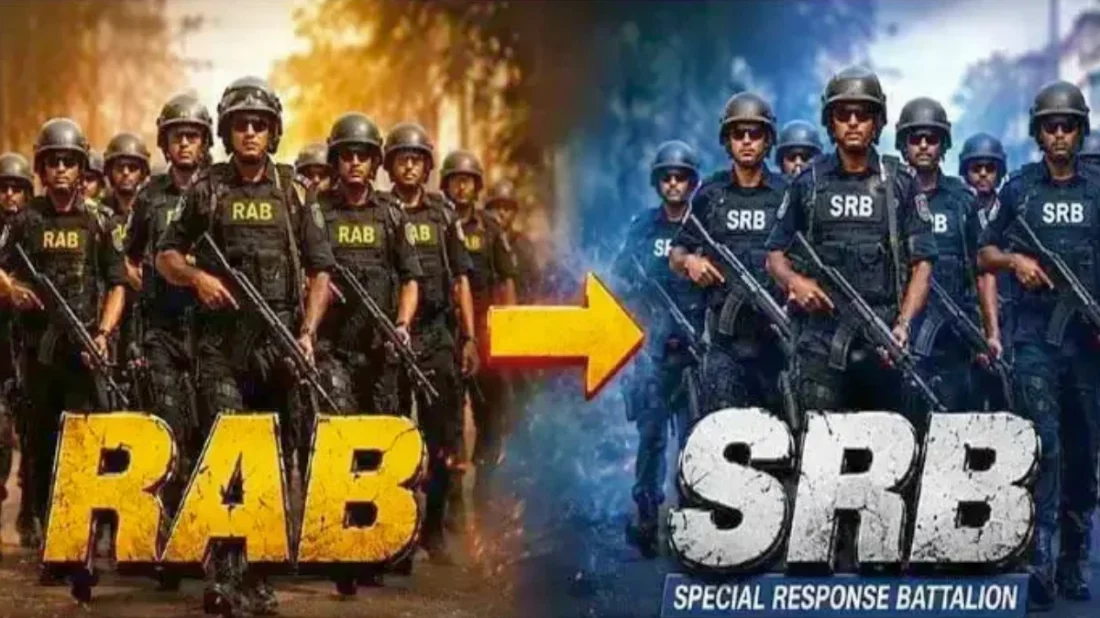
RAB Dissolved, SRB Begins Operations; Uniforms, Logos, and Vehicle Colors to Change

Published: 12:32 17 September 2026
After more than two decades, the Rapid Action Battalion (RAB) has been officially dissolved. In its place, the Special Response Battalion (SRB) has commenced operations as a specialized unit under the Bangladesh Police. The force began functioning under its new name on September 16, following the enactment of the ‘Special Response Battalion Act, 2026’.
The decision to dissolve RAB was implemented through the publication of a government gazette. The new legislation was published as Act No. 19 of 2026. Prior to this, the SRB Bill was passed in the National Parliament on September 10. With the law coming into effect, the provisions regarding the formation and operation of RAB contained in the Armed Police Battalions Ordinance, 1979, have been repealed.
However, not everything at the field level is changing immediately upon the name change. Work is underway to finalize the SRB's distinct uniforms, logos, member badges, and vehicle colors. These changes will be implemented in phases; consequently, officials have indicated that the new force will initially utilize some of the equipment, vehicles, and infrastructure previously used by RAB.
Formed in 2004, RAB served for a long period as a specialized law enforcement unit in the country. Although the new law alters the force's name and legal framework, it includes provisions to directly transfer a significant portion of its existing personnel and assets to the SRB.
Under the law, RAB's relevant personnel, orders, powers, authority, and existing benefits will be transferred to the SRB. Simultaneously, RAB’s funds, cash, bank deposits, liabilities, contracts, movable and immovable properties, account books, registers, records, and other documents will also come under the new unit.
The SRB will operate as a specialized unit under the Bangladesh Police. Personnel from the police and other disciplined forces may be assigned or deputed to the unit based on government requirements. A provision has been made for the force to be led by an officer holding the rank of Additional Inspector General of Police.
The primary mandate of the new force will be to ensure public safety, combat terrorism and organized crime, and suppress serious offenses. Combating drug trafficking, human trafficking, cybercrime, illegal possession of arms and explosives, kidnapping, murder, and serious crimes against women and children will also fall within the SRB's mandate.
The SRB has been granted the authority to investigate criminal offenses. In accordance with the law and applicable provisions, the force is empowered to conduct searches, make arrests, and seize evidence or assets. It is also authorized to investigate specific offenses upon the directives of the court, the government, or the Inspector General of Police.
The new law also incorporates specific measures for accountability. Provisions have been made to establish a grievance redressal committee to handle complaints from the general public as well as internal grievances from SRB members. Upon verifying a complaint and finding prima facie evidence, the committee may recommend that the relevant authorities take necessary action.
Provisions for departmental action against force members for acts of indiscipline have also been included. Furthermore, existing departmental disciplinary proceedings or court cases against RAB will not be nullified by the enactment of the new law. The 2005 regulations governing RAB's court procedures and departmental proceedings will remain in effect until new rules are formulated.
However, the transfer of the majority of RAB's personnel, powers, and assets to the SRB sparked debate in Parliament. Some opposition members demanded greater accountability for the new force and questioned the extent of actual change, given that a significant portion of the old structure remains intact. Conversely, discussions within the parliamentary committee emphasized ensuring training, professionalism, transparency, and accountability alongside the utilization of existing skilled personnel and equipment.
Consequently, while the name "RAB"—familiar for over 22 years—is being officially retired, changes at the field level will occur in phases. The SRB's distinct identity will become more visible with the introduction of new uniforms, insignias, badges, and vehicle color schemes. At the same time, the practical effectiveness of the accountability and grievance redressal mechanisms mandated by the new law will be a crucial aspect of the new force's operations.
Advertisement
Most Readed - National



- $6 Million Jewelry Heist: Why Did Kim Kardashian Receive Only €1 in Compensation?
- Price of Low-Tier Cigarettes Raised Again; 10 Sticks Now Cost Tk 65
- Shibir President Speaks on Mega Projects Amid Allegations of $234 Billion Money Laundering
- Raphinha Equals Messi's Record; Barcelona Makes History in 7-Goal Thriller
- Major blow for international students: Australia limits opportunities to bring families
- RAB Dissolved, SRB Begins Operations; Uniforms, Logos, and Vehicle Colors to Change
- Born in Prison, 7-Year-Old Mobashera Steps into Freedom Holding Her Mother's Hand
- The little-known chapter of the Jinnah-Sheikh Mujib relationship: what happened in the 1946 elections?
- Can't get over your ex? Here’s what you can do to move on.
- Electric Trains to Run on Narayanganj-Dhaka-Joydebpur Route; Cost: Tk 3,822 Crore
- 15 artists including Boga Taleb to sing in memory of Razzak Dewan
- Joining the Mecca Pact is Bangladesh's own matter: Jamaat Ameer
- Dr. Tasnim Zara: Education, Career and Politics
- Iran is losing control of the Strait of Hormuz
- AC explosion in Pakistani hospital, 15 newborns die
- Sugarcane cultivation is changing the fate of farmers, opening up additional income avenues
- Salman Shah, the evergreen hero of Bengali cinema, lost untimely
- NBR to be split into two independent institutions: Finance Minister
- Rain forecast for five more days across the country
- Bangladeshi football will not change just by playing with Brazil, says Aminul