Poet Sufia Kamal: The Woman Who Helped Change an Era with Her Pen

Published: 11:27 18 September 2026
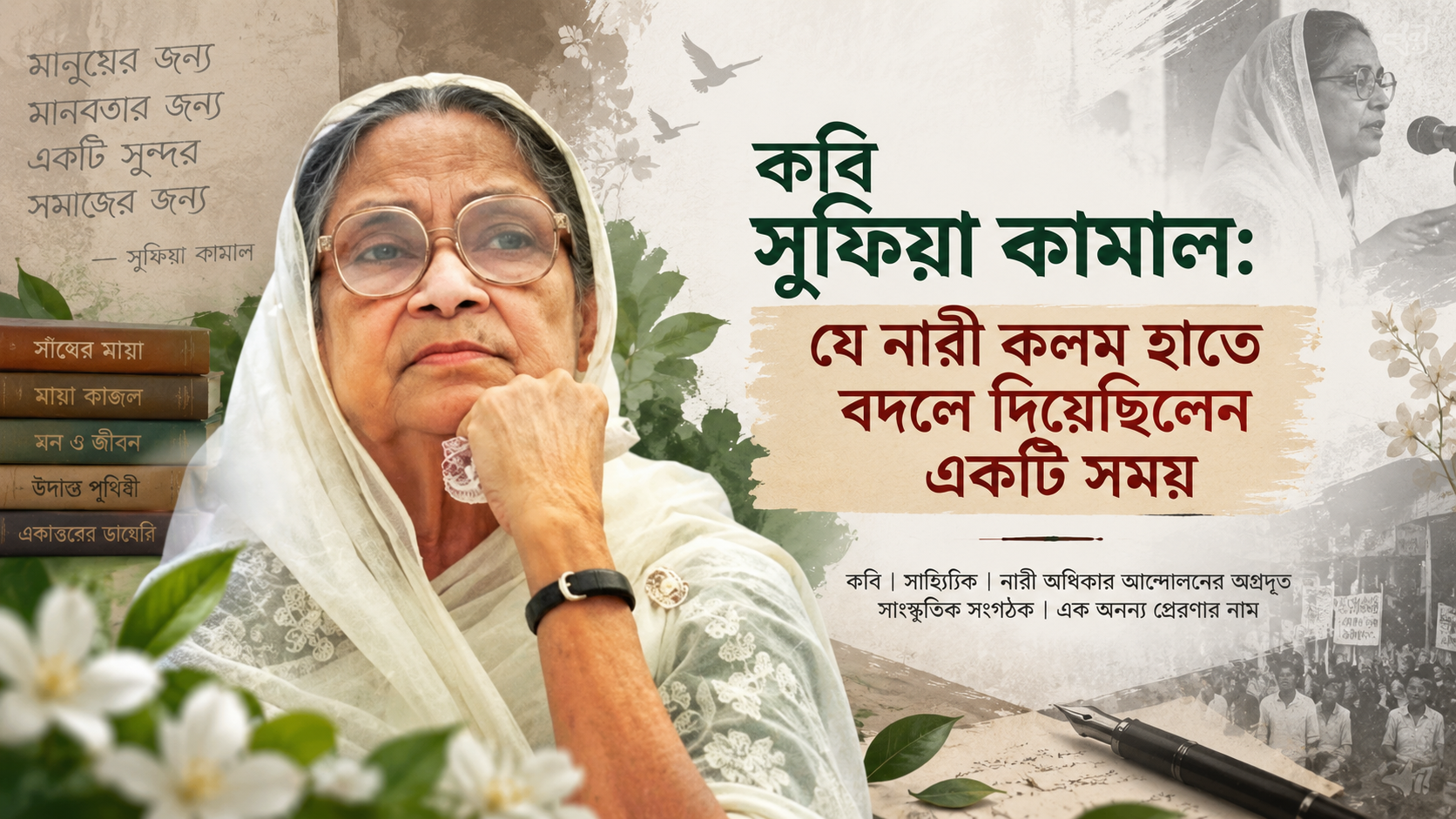
A woman who had very limited access to formal education. She grew up at a time when it was difficult for women from Muslim families even to move freely outside their homes. Yet that same woman would one day become one of Bangladesh’s most prominent poets, a pioneer of the women’s rights movement, and a leading figure in the Bengali social and cultural movement.
She was poet Begum Sufia Kamal.
She did not earn her place in history through poetry alone. Her lifelong involvement in issues of language, culture, women’s rights, and human dignity gave her a unique position in the history of Bangladesh.
Childhood: How Her Learning Began Without Attending School
Sufia Kamal was born on June 20, 1911, in Shayestabad, Barishal, into a respected family. Her father, Syed Abdul Bari, was a lawyer, and her mother was Sabera Banu.
Because of the social and family customs of that time, she did not have the opportunity to attend a regular school. She learned Urdu, Arabic, and Persian at home. Her introduction to the Bengali language came mainly through her mother and maternal uncle.
In other words, the woman who would later become one of the most important female poets in Bengali literature began her education not in a conventional classroom, but at home.
The Meeting at Age Seven That Influenced Her Life
In 1918, while visiting Kolkata with her mother, young Sufia met Begum Rokeya Sakhawat Hossain.
Sufia Kamal was only seven years old at the time.
Her meeting with Begum Rokeya, a pioneer of women’s education and women’s awakening, had an important influence on her later thoughts and worldview.
Sufia Kamal herself would eventually become one of the most prominent organizers of the women’s rights movement.
Married at 12, But Her Writing Never Stopped
At the age of only 12, Sufia Kamal married Syed Nehal Hossain. Her husband, however, encouraged her literary activities and social work.
Despite the social restrictions of the time, Sufia Kamal began working for disadvantaged women while continuing her Bengali literary practice.
In 1923, her first short story, “Sainik Badhu,” was published. She was still a teenager.
It was not only the debut of a new writer, but also a significant moment for a Muslim woman entering the literary world during a highly conservative period.
Entering the World of Poetry with the Encouragement of Kazi Nazrul Islam
Another fascinating chapter of Sufia Kamal’s literary life is connected with Bangladesh’s national poet, Kazi Nazrul Islam.
While living in Kolkata, she became acquainted with Nazrul. After reading her poetry, he was impressed and encouraged her to publish her work.
In 1926, her first poem, “Basanti,” was published in the literary magazine Saugat.
From that point onward, her literary journey continued to grow.
Her first poetry collection, “Sanjher Maya,” was published in 1938. Over time, Sufia Kamal became a widely recognized and important name in Bengali poetry.
Meeting Mahatma Gandhi and Spinning the Charkha
One of the lesser-known episodes of Sufia Kamal’s life took place in 1925.
She met Mahatma Gandhi in Barishal. Inspired by Gandhi’s Swadeshi ideals during the Indian independence movement, Sufia Kamal began spinning thread on a charkha.
Gradually, her lifestyle also changed. She moved away from the luxurious clothing of her childhood and began wearing traditional handwoven sarees commonly worn by Bengali women.
This episode shows that her social consciousness was not limited to her writing; it also shaped her personal way of life.
Sufia Kamal as a Literary Figure
Sufia Kamal’s poetry explored nature, love, and personal emotions, while also addressing patriotism, social realities, language, the Liberation War, and human suffering.
Some of her notable works include—
Sanjher Maya
Maya Kajal
Mon O Jibon
Udatto Prithibi
Prashanti O Prarthana
Diwan
Mor Jaduder Samadhi Pore
Ekattorer Diary
Her writings especially reflected the experiences, emotions, and realities of the 1971 Liberation War.
Her Connection with Begum Magazine
When Begum magazine began publication from Kolkata in 1947, Sufia Kamal played an important editorial role during its early period.
Following the Partition of India, she moved to Dhaka in the same year.
After arriving in Dhaka, her life was no longer centered only on literature. Her involvement in cultural, social, and women’s rights movements gradually became much deeper.
Sufia Kamal and the Women’s Rights Movement
One of the most important aspects of Sufia Kamal’s identity was her role in the movement for women’s rights.
In 1970, the East Pakistan Mahila Parishad, which later became the Bangladesh Mahila Parishad, was established with significant involvement from Sufia Kamal. The organization worked toward equal rights for women and men, women’s empowerment, and the creation of a society free from discrimination.
She became one of the central founding leaders of the Bangladesh Mahila Parishad.
Not Only a Poet, But Also a Cultural Organizer
Sufia Kamal also played an important role in the cultural movement of Bangladesh.
Her name is closely associated with organizations such as Chhayanaut, Kochi-Kachar Mela, and Bangladesh Mahila Parishad.
She was also actively involved in important political and cultural movements, from the Language Movement to the period leading up to the Liberation War, as well as later democratic movements.
She Even Returned a State Award in Protest
One of the most remarkable facts about Sufia Kamal’s life is that she did not simply accept awards—she also returned one as an act of protest.
In 1961, the Government of Pakistan awarded her the Tamgha-e-Imtiaz.
However, in 1969, she returned the state honor in protest against the Pakistani government’s repression of Bengalis.
The incident showed that, for Sufia Kamal, personal recognition was less important than her principles and convictions.
Notable Awards Received by Sufia Kamal
During her lifetime, she received numerous national and international honors.
Some of the most notable include—
Bangla Academy Literary Award — 1962
Ekushey Padak — 1976
Muktadhara Award — 1982
Begum Rokeya Padak — 1996
Independence Award — 1997
She also received several international honors during her lifetime.
7 Lesser-Known and Interesting Facts About Sufia Kamal
- She did not receive regular institutional schooling, yet she became one of the most important poets in Bengali literature.
- She met Begum Rokeya when she was only seven years old.
- Her first short story was published in 1923 while she was still a teenager.
- Kazi Nazrul Islam read her poetry and encouraged her to publish it.
- In 1925, she met Mahatma Gandhi and began spinning thread on a charkha under the influence of the Swadeshi movement.
- She returned the Tamgha-e-Imtiaz awarded by the Pakistani government in 1969 as an act of protest.
- After her death in 1999, she was buried with full state honors. She is widely recognized as the first woman in Bangladesh to receive such an honor.
The Final Chapter of Her Life
Sufia Kamal died in Dhaka on November 20, 1999, at the age of 88.
She was buried at Azimpur Graveyard in Dhaka. Her funeral was conducted with state honors, and various sources identify her as the first woman in Bangladesh to receive this distinction.
Why Is Sufia Kamal Still Relevant Today?
If Sufia Kamal’s life is viewed simply as the biography of a poet, a large part of her contribution is missed.
She belonged to a generation that did not separate literature from society.
On one hand, she wrote about nature, love, and personal feelings. On the other, she remained actively involved in issues such as women’s rights, the Bengali language, culture, and social inequality.
Even decades after her death, discussions about her life and work continue. In 2019, Google honored her 108th birth anniversary with a special Doodle. New generations continue to discover and reinterpret her literary legacy.
Final Thoughts
Sufia Kamal’s life presents a remarkable contrast.
The girl who did not have the opportunity to attend a regular school eventually received the Bangla Academy Literary Award, the Ekushey Padak, and the Independence Award.
In a society where women’s freedom of movement was restricted, she became a leader in the movement for women’s rights.
And although she wrote poetry in a gentle and sensitive voice, when necessary, she became a powerful voice of protest.
For this reason, Sufia Kamal was not merely a poet of Bengali literature—she remains an important chapter in the history of Bangladesh’s literature, culture, and women’s awakening.
Advertisement
Most Readed - Biography



- Dev’s response to comparisons with Uttam Kumar wins praise online
- Poet Sufia Kamal: The Woman Who Helped Change an Era with Her Pen
- "Jinnah's father sold fish; he was a Hindu": Fazlur Rahman's claim vs. historical records
- Gunvor's First LNG Cargo from the US Arrives in Bangladesh; Unloading Begins
- Akbar Ali Set for Debut in Overseas Franchise League; to Play for Karnali Yaks
- 48 Dead in Nigeria After Consuming Toxic Alcohol
- BNP is a centrist party positioned ‘to the right of the Left and to the Left of the Right’: Law Minister
- $6 Million Jewelry Heist: Why Did Kim Kardashian Receive Only €1 in Compensation?
- Price of Low-Tier Cigarettes Raised Again; 10 Sticks Now Cost Tk 65
- Shibir President Speaks on Mega Projects Amid Allegations of $234 Billion Money Laundering
- 15 artists including Boga Taleb to sing in memory of Razzak Dewan
- Joining the Mecca Pact is Bangladesh's own matter: Jamaat Ameer
- Dr. Tasnim Zara: Education, Career and Politics
- Iran is losing control of the Strait of Hormuz
- Salman Shah, the evergreen hero of Bengali cinema, lost untimely
- AC explosion in Pakistani hospital, 15 newborns die
- Bangladeshi football will not change just by playing with Brazil, says Aminul
- Rain forecast for five more days across the country
- Australian captain impressed by Shariful's bowling
- Rafsan and Sunehra in Bachelor Point's flat, there will be a new surprise